

Design Judgement:
The Evloutionary Structure of Rapid Judgement
Humans evolved to make rapid judgments in order to survive.
Is it safe? Is it threatening?
Such judgments could not afford delay.
When confronted with a moving silhouette hidden within pitch-black undergrowth, the ability to interpret its form was directly tied to survival.
As a result, the human visual system developed a tendency to translate visual information into meaning almost instantaneously.
Angular silhouettes imply tension and aggression, while rounded forms suggest softness and non-threatening intent. A low center of gravity conveys stability, whereas elevated positions evoke instability.
These interpretations are not always accurate. Yet, in an evolutionary context, fast approximation proved more advantageous than perfect accuracy.
When we watch a car pass by on the street, we make judgments effortlessly.
The language we use is often simple:"It's beautiful.""It's ugly."
More often than not, the evaluation is reduced to one of these two categories.
Yet beneath such expressions lies a complex mixture of emotional responses.
These impressions arise immediately, and the judgments themselves are remarkably concise. The fact that we instinctively form such impressions of automobiles may stem from the very same evolutionary mechanisms that once helped our ancestors navigate threats and opportunities in their environment.
These judgments occur almost instantaneously. Yet speed should not be mistaken for simplicity. On the contrary, a highly complex cognitive process is compressed into that brief moment of evaluation.
At minimum, this process unfolds through four stages.
(1) Perception
We first register visual information such as form, proportion, directionality, surface treatment, light and shadow, and contrast.This stage belongs to the sensory system and operates almost immediately.
(2) Emotional Response
The perceived form then triggers an emotional reaction.A low-slung body conveys stability. A forward-leaning silhouette generates tension. A wide stance creates an impression of power.At this stage, sensation transforms into emotion.
(3) Interpretation
We subsequently interpret those emotional responses through the lenses of society, culture, brand context, and personal experience."This design feels too aggressive for the brand's identity."
"I've seen this type of design too many times; it feels clichéd."
"This design seems overly radical."Here, cultural experience, brand narratives, and individual taste begin to intervene.
(4) Verbalization
Finally, we express our judgments through language. Yet this language is often ambiguous.What do we actually mean when we describe a design as "aggressive"?Are we referring to its center of mass? Its visual weight distribution? The spatial relationships between elements?
Because these four stages operate in rapid succession—often almost simultaneously—they are experienced as a single intuition.
Structurally, however, aesthetic judgment is better understood as a complex cognitive chain.
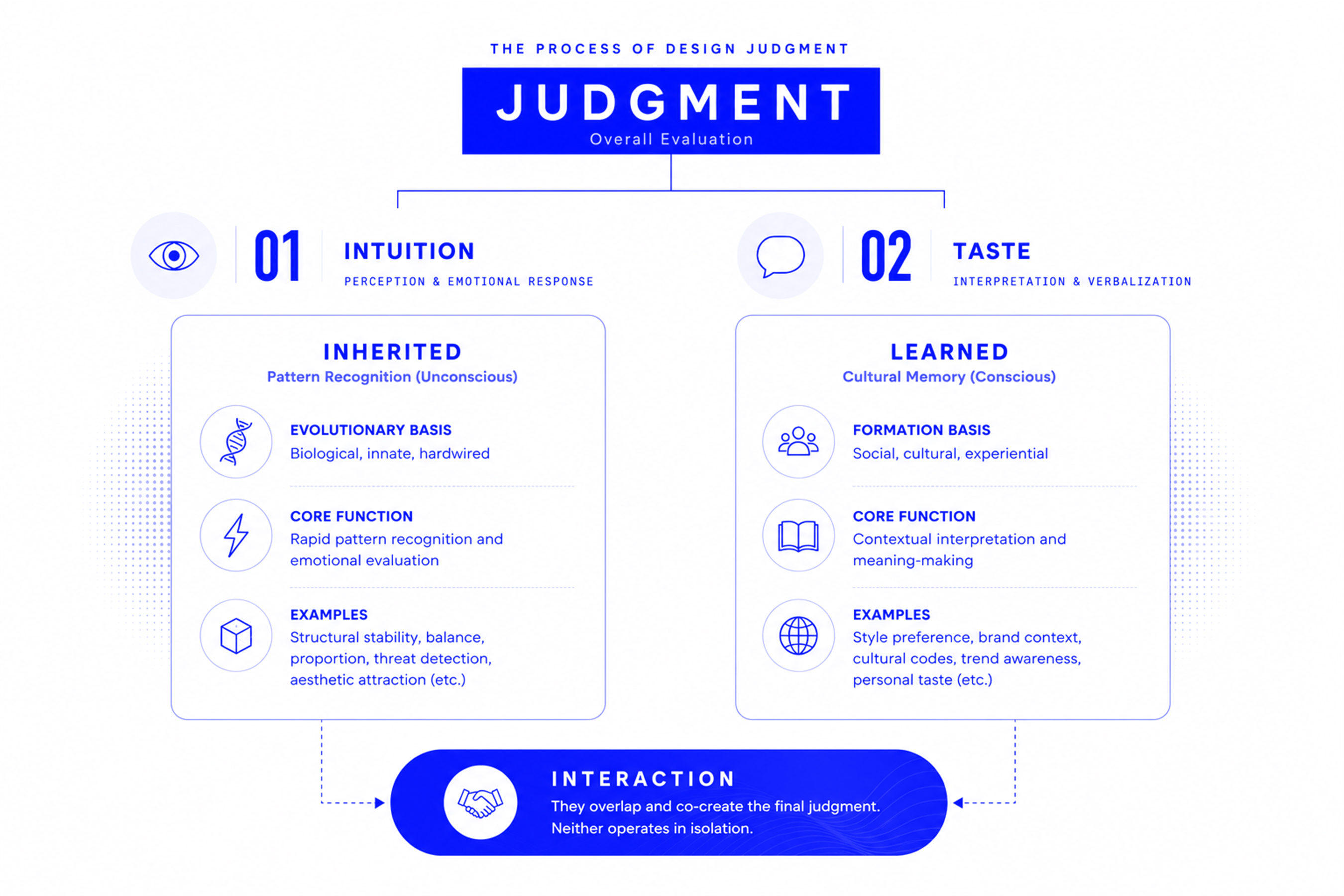
Within this framework,
Perception and emotional response belong to the domain of intuition: immediate, automatic, and largely unconscious processes.
Interpretation and verbalization belong to the domain of taste: conscious, reflective, and culturally mediated processes.
Intuition, in this sense, can be understood as an inherited pattern-recognition algorithm shaped through evolutionary processes and embedded within our unconscious cognition.
Taste, by contrast, can be understood as learned cultural memory, formed through social influence, accumulated experience, and contextual learning.
These two systems do not stand in opposition to one another.
They overlap. They operate simultaneously. Together, they shape how we judge the forms we see.
디자인 판단:
빠른 판단의 진화생물학적 구조
인간은 생존을 위해 빠른 판단을 내려야 했다.
안전한가? 위협적인가?
이러한 판단은 지연될 수 없었다.
칠흙같은 어둠 수풀 속 움직이는 실루엣을 보았을때, 그 형태를 해석하는 능력은 곧 생존과 직결되었다.
따라서 인간의 시각 체계는 시각적 형태 정보를 즉각적으로 의미로 번역하는 경향을 가진다.
각진 실루엣은 긴장과 공격성을, 둥근 형상은 부드러움과 비위협성을 암시한다. 낮은 무게 중심은 안정성을, 높은 위치는 불안정을 연상시킨다.
이러한 해석이 항상 정확한 것은 아니다. 그러나 진화적 맥락에서는 “완벽한 정확성”보다 “빠른 추정”이 유리했다.
길에서 자동차가 지나가는걸 보며 우리는 쉽게 판단한다. 그 언어는 간단 하다:
“아름답다” 혹은 “못생겼다” 둘중에 하나일 가능성이 크다. 하지만 그 표현 아래에는
“역동적이다.”
“불안하다.”
“공격적이다.”
“고급스럽다.”“귀엽다.” 등 여러가지 감정이 섞여있다.
그 감정들은 즉각적이며 판단은 간단 명료하다. 자동차를 보며 우리가 즉각적으로 이런 판단을 내리는것은 아마 진화적 맥락으로 같은 이치일 것이다.
이 판단은 거의 순간적으로 발생한다. 그러나 그 속도는 단순함을 의미하지 않는다. 오히려 그 안에는 복합적인 인지 과정이 압축되어 있다.
그것은 최소 네개 단계의 과정을 거쳐 형성된다.
(1) 지각 Perception
우리는 먼저 형태, 비율, 방향성, 표면, 명암, 대비등 시각적 정보를 인식한다. 이 단계는 즉각적으로 감지되는 감각체계이다.
(2) 감정 반응 Emotional Response
지각된 형태는 곧바로 정서적 반응을 유발한다.
낮게 깔린 차체는 안정감을, 전방으로 기울어진 실루엣은 긴장감을, 넓은 스탠스는 힘의 인상을 생성한다.이 단계에서 감각은 감정으로 전환된다.
(3) 해석 Interpretation
이후 우리는 그 정서적 반응을 사회,문화, 브랜드등의 맥락에 따라 해석한다
“이 디자인은 너무 공격적이라 브랜드 방향성에 맞지 않아 .”
“이건 너무 많이 본 디자인이라 식상해”
“이 디자인은 너무 급진적인 것 같아여기서 문화적 경험, 브랜드 맥락, 개인적 취향이 개입한다.
(4) 언어화 Verbalization
마지막으로 우리는 그 판단을 언어로 표현한다. 그러나 이 언어는 대개 모호하다.
“공격적”이라는 말은 실제로 무엇을 지칭하는가?중심 배치? 무게 배분? 요소 간 거리 관계?
이 네 단계는 거의 동시에 작동하기 때문에 하나의 직관처럼 느껴진다. 그러나 구조적으로 보면, 미적 판단은 복합적인 인지 연쇄다.이중 지각과 정서반응은 즉각적이고 자동적으로 일어나는 직관의 영역으로, 해석과 언어화는 의식적이고 적극적인 취향의 영역으로 나눌 수 있다.
그리고 직관은 진화생물학적 단계에서 무의식에 형성된 Inherited Pattern recognition (유전적 패턴인식 알고리즘)으로, 취향은 사회적 영향으로 형성된 learned Cultural Memory (학습된 문화적 기억) 으로 연결 시킬 수 있다.
이 둘은 대립하지 않는다. 겹쳐 작동한다.